

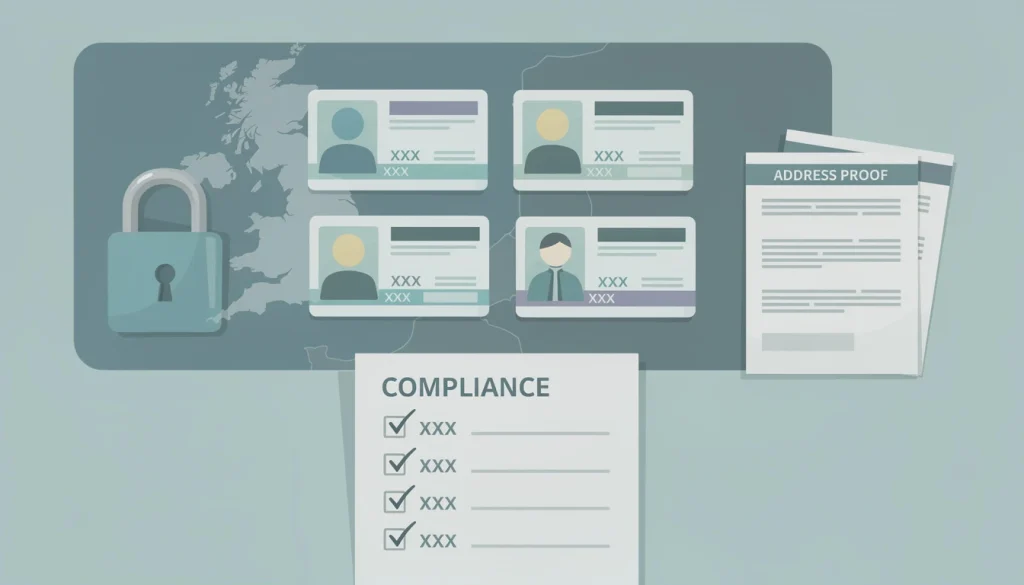
The Dreams Casino KYC policy allows the operator to request government-issued photo identification, a selfie-style identity-validation image with the document, bank statements or utility bills as proof of residence and any further records the operator considers necessary to determine identity, location and payment ownership. The Terms set a minimum age of 21 or the legal gambling age in the user’s jurisdiction (whichever is higher), one account per player and per household, accurate registration data and authorised ownership of the payment method. Service, payment and withdrawal can each be restricted until identity is sufficiently determined. The KYC policy also lists the United Kingdom under a restricted-country criterion at the proof-of-identity stage, which adds a second layer to the country restriction documented on the UK availability and country restrictions page.
Document categories the operator can request
The KYC policy lists four document categories. Government-issued photo identification covers passports, national identity cards or driving licences with photograph and date of birth. The identity-validation photograph is a selfie-style image of the account holder holding the identification document, used to match the person to the document. Proof of address typically uses a recent utility bill or a bank statement issued in the account holder’s name. The operator also reserves the right to ask for further records, such as additional bank statements, that it considers necessary to clarify identity, location or payment ownership.
The policy does not commit to a fixed checklist. The operator can ask for any combination of these documents at any point in the account lifecycle, and can request additional records if the standard set leaves a question unresolved. This is broader discretion than at most UK-licensed operators, where the KYC document set is shaped by Gambling Commission rules and Source-of-Funds expectations. At an offshore brand like Dreams Casino, the document burden is set by the operator and is enforced at the points the operator considers material — most frequently at the cashout, as documented on the withdrawal-risk analysis page.
| Document category | Typical evidence | What it verifies |
|---|---|---|
| Photo identification | Passport, national ID, driving licence with photo and date of birth | Identity and age threshold. |
| Identity-validation photograph | Selfie-style image of the account holder holding the photo ID | Match between the person and the document. |
| Proof of residence | Recent utility bill or bank statement in the account holder’s name | Account holder’s address and location. |
| Payment-method records | Statement or screen capture connected to the payment method used | Authorised ownership of the deposit and withdrawal route. |
| Additional records | Whatever the operator considers necessary on a case basis | Operator discretion at AML, location and risk-control level. |
One-account-per-household and registration-data rules
The Terms set one account per player and per household. Multiple accounts can lead to closure of all accounts associated with the household and cancellation of outstanding withdrawals. The Casino Guru complaint set for Dreams Casino includes case files in which the operator closed accounts under this rule after reviewing the supporting documentation. The household-level scope means players who share an address with another existing account holder are inside the rule, even if the names on the accounts are different.
Registration-data accuracy is a separate and equally important condition. Names, addresses, dates of birth, contact details and the country recorded at registration must match the documentation provided at KYC. Inaccurate or incomplete registration data is grounds for account suspension, payment hold or cancellation of withdrawals. The Terms also require the user to be the authorised owner of any payment method used to fund the account: a deposit made by a card or bank account belonging to a different person is a Terms breach, regardless of any informal agreement between the parties involved.
Payment ownership matters most at the cashout stage. The operator’s FAQ explicitly states that withdrawals cannot be returned to a credit card, which already forces a method change between deposit and payout. If the alternative withdrawal route (bank wire, check or Bitcoin) cannot be matched to the registered account holder by name and address, the request is paused until ownership is established. Withdrawal-side detail is on the withdrawal-risk analysis page.
Age threshold, country-restriction criterion and service holds
The minimum age in the Terms is 21 or the legal gambling age in the user’s jurisdiction, whichever is higher. That is a higher threshold than the 18-year minimum at UK Gambling Commission-licensed operators, but the threshold itself is irrelevant for a UK reader because the country restriction places the United Kingdom outside the operator’s permitted markets. The KYC policy then doubles up that exclusion by listing the United Kingdom in its restricted-country criterion at the proof-of-identity review stage.
Service holds in the policy are not limited to one type. The operator can restrict access to the lobby, hold pending deposits, suspend bonus accrual, pause withdrawal processing or close the account, in any combination. The triggers include unresolved KYC, country-restriction findings (the 2026 Casino Guru case in which the operator confiscated 4,500 USD after identifying VPN use is on the complaints and reputation review page), suspected dishonesty, integrity concerns, multiple-account findings and breaches of bonus terms. None of these triggers requires advance notice; the operator can apply them when the condition is observed.
Dormant accounts and account closure
The Terms describe an inactive-account policy. An account with no logged activity for a defined period (third-party reviews cite two years) can be treated as dormant, with the balance subject to administrative handling and the account potentially closed. The relevant requirement for an active account is that the holder maintains access to the registered email address, because dormancy notifications and reactivation flows are typically sent to that address. Where notice is sent to an inaccessible email and the account remains inactive, the dormant-account clause operates without the holder seeing it.
Account closure can also be voluntary. The Terms allow a player to request closure through support, and an active deposit limit, cool-off period or self-exclusion request must be set through support channels rather than configured in a self-service section. That contrasts with UK Gambling Commission-licensed operators, where deposit limits, cool-off periods and self-exclusion can be configured in-account at any time as a regulatory requirement. The detailed contrast with UK consumer-protection tooling is on the UK due-diligence checklist page.
Responsible-gambling tools inside and outside the operator account
Inside the operator account, the Terms mention deposit limits, cool-off periods and self-exclusion through support channels. These are not in-account self-service controls; they require contact with the support team to activate, which adds friction at the point a player most needs to act. The Terms do not document UK-style mandatory affordability checks, statutory stake limits or operator-funded research-prevention-treatment levy contributions, because the operator is not licensed in the UK and is not subject to those rules.
Outside the operator account, the tools that work for UK users are unrelated to Dreams Casino’s controls. GAMSTOP at gamstop.co.uk operates self-exclusion across all UK Gambling Commission-licensed online operators. Most UK banks offer free gambling-transaction blocks that prevent any transaction coded as gambling from leaving the account, including transactions to offshore casinos. GamCare’s blocking-software guidance documents device-level options that prevent gambling websites from loading at all. These external tools work regardless of any account control the offshore operator does or does not provide.
What this account framework means in practice
The cumulative effect of the Dreams Casino account and KYC framework is that documentation, ownership and country-restriction enforcement converge at the cashout. A player can deposit, play and accumulate winnings without delivering full documentation, but a withdrawal request triggers a full review against documents, payment ownership, country restriction, account history and bonus playthrough. Disputes at this stage are common across reputation surfaces; the patterns are summarised on the complaints and reputation review page.
For a UK reader, the framework is documented for due-diligence reading only. The country restriction in the operator’s Terms and the parallel KYC restricted-country criterion both place the United Kingdom outside the operator’s permitted markets. The licence and operator-identity trail is on the UKGC licence and operator check page; the verification framework for any UK-facing casino brand is on the UK due-diligence checklist page; the hub view is at Dreams Casino UK review.
Sources used for this page
- Dreams Casino Terms and Conditions — eligibility, age threshold, one-account rule, payment ownership, suspension, dormant-account and responsible-gambling clauses, reviewed on 2 June 2026.
- Dreams Casino KYC Policy — document categories and restricted-country criterion at identity-document review.
- Dreams Casino FAQ — deposit-to-withdrawal method logic, credit-card payout exclusion and photo-identification cashout note.
- Casino Guru Dreams Casino review and complaint case files — multi-account closures and country-restriction enforcement cases.
- UK Gambling Commission public business register — context for the GB-licensed alternative framework.
- GamCare blocking-software guidance — device-level UK consumer-protection tools.